Showing posts with label Air Mail. Show all posts

18 October 2016

Addresses can be tricky

This letter was mailed on Friday 9 March 1945. It went via England and was examined by the censors there, the war was still going on. Another note on the cover gives away the weight, 8 g. The fee for international letters was 30 öre and the air mail fee was then 1.30 kr. This must have been and urgent letter.

The address on the cover is not completely accurate, it should be The Crosley Corporation, not Crossley Corporation. They resided on 1329 Arlington Street, Cincinnati, Ohio. This is the famous Crosley Corporation that among many things manufactured radios, appliances, car parts and even cars, the latter less successfully.


International letter air mail, fee: 30 öre + 1.30 kr = 1.60 kr, max 10 g.
1939, February 10. 60 öre red-carmine Three Crowns. Qty: 77,900,000.
1939, September 22. 1 kr orange Three Crowns. Qty: 141,000,000


The sender's address is even more tricky to understand. The organisation, most likely a company, called Lincoln J:r was the sender. There are no traces of a firm called Lincoln in Stockholm during the 40s on the Internet. Stockholm 10 below the name indicates that their address is a Post. Office Box at the Post Office Stockholm 10 situated at 34 Narva Road (Narvavägen 34).

The stamps are from the Three Crown series and the 60 öre was the first stamp issued in the series and the 1 kr was the one that was printed in the largest quantity and probably the one that was in use the longest. A beautiful combination.


Here is the old building were the Post Office Stockholm 10 was situated. The Post Office moved in to a new building at the same corner in the 70s and was open until October 2002. (Photo: Stockholmskällan.)


The old Crosley Corporation industrial facilities at 1329 Arlington Street are in a really bad state. The building has ten stories and is located in the Camp Washington neighborhood of Cincinnati, Ohio.


The letter ended eventually up here - 1329 Arlington Avenue, Cincinatti, Ohio, U.S.A.
(Photo: Google Maps).


12 October 2016

A letter at Christmas time

The letter cover is really thin and grey, an old fashion ink pen was used and it looks like the sender maybe was a little bit uncomfortable using a pen. Hardly any capital letters were used. The sender was Mr. Emil Göransson living in the small hamlet of Fagerhult, about 10 km north of the Post Office Göteryd.

The letter was handled by the Göteryd Post Office on Thursday 6 December 1945. The postal fee was 95 öre and indicates that the weight was under 5 g.


International letter  air mail, fee: 0.30 kr  + 0.65 kr = 0.95 kr, max 5 g.
1941, 26 April. Gustaf V, right profile. Qty: 18,600,000
1940, 8 April. 40 öre olive-green Gustaf V, right profile. Qty: 84,100,000
Commemorative stamp:                                                                            
1945, 29 May. 5 öre green Tercentary of Swedish Press. Qty: 80,600,000


The clerk at the Post Office had good use of the Gustaf V, right profile, series in this case, but a commemorative stamp sneaked in at the right corner. They could have used the 5 öre green Gustaf V. Note that the commemorative stamp is also coloured in the correct UPU-colour - green for international printed matter. Göteryd Post Office closed its door for good in spring 1967.

The letter went by air to Mrs. Antosa U. Johnson living in Minneapolis, MN, in U.S.A.


The letter went from this Post Office to America. (Photo: Google Maps).


. . .  and ended up here in the household of Mrs. Johnson in Minneapolis. (Photo: Google Maps).

Where is the place:
Göteryd is situated 394 km SW of Stockholm, the distance by road is 472 km.


11 April 2016

Grand Hôtel

Even Stockholm has a Grand Hotel, the most well-renowned and prestigious hotel in the capital. The luxurious hotel have had many famous guests in its days   . . . one of the lesser known guests was Mr. Nils Ivar Malmström that spend some days there during fall 1952. He was on a trip back to the old country. Mr Malmstrom had emigrated to USA earlier in the 20th century and by now he owned his own company together with his partner Richard Malmstrom (maybe his son?). The company was in in the chemical industry and they were specializing in Lanolin, which is refined wool wax or wool grease.


International letter airmail, fee: 1.30 kr, 15 g?
1951, 6 June. 30 öre blue Gustaf VI Adolf type I. Qty: 21,800,000
1939, 22 September. 1 kr orange Three Crowns. Qty: 141,000,000


I am not really sure about the 1.30 kr rate.The rates for airmail were not uniform in any way. There were specialized rate for different regions of the world and they changed frequently. My guess is that the letter weighed 15 g or less.

Anyway, a 30 öre blue Gustaf VI Adolf type I which used to cover the rate for international letter - 20 g until June 1952 was applied. In October 1952 when this letter was mailed it had no single use anymore. Also a 1 kr orange Three Crown stamp was added in order to sum up to 1.30 kr. The 1 kr orange was the most common Three Crown stamp.

The letter was handed over to the Post Office Stockholm Ban in the afternoon of 13 October 1952, a Monday. The Stockholm Ban was the Post Office at the Stockholm Central Station. The letter went to the company's address in Brooklyn, a quick look at Google maps show no trace of the company. Actually it looks more like a waste land.


On the reverse side on the letter cover Mr. Malmstrom has written his present address: Grand Hotel, Stockholm.

Mr. Malmstrom crossed out his home address, which was 209 Park Street, Montclair, New Jersey. That house is still standing.


4 March 2016

Relatives on 55th Street

It seems like Mrs. Bertha Ahl mailed  a letter to a relative in New York City on Wednesday 9 March 1949. Maybe Mr. Walter E. Ahl was her brother that immigrated to America some decades earlier? We do not know . . .   but it looks like an older person's handwriting and an old fashioned ink pen was used as well. According to the backside of the letter Mrs. Ahl lived in a village called Skruv just north of Klavreström, a small place between Växjö and Vetlanda in the province of Småland, (299 km south west of Stockholm, 380 km by road.)

It is an air mail letter and the fee paid by Mrs. Ahl was 95 öre which indicates that the letter was weighing 5 g or less.

Air mail  - 5 g, fee: 95 öre
1941, 23 January. 35 öre carmine-violet Gustaf V, right profile, type II. Qty: 20,000,000.
1939, 10 February. 60 öre red-carmine Three Crowns. Qty: 77,900,000

The clerk at the Post Office in Klavreström used two stamps; the 35 öre carmine-violet Gustaf V, right profile, type II and the 60 öre red-carmine Three Crown. The 60 öre Three Crowns was a pretty common stamps in the forties, its main purpose was to be used for domestic parcels weighing up to 1 kg. It was also the first stamp in the long running Three Crown series - read more about that series here. The 35 öre carmine violet is a little bit rarer, in 1949 there was no obvious single use, but earlier it could be used as a single stamp for registered domestic letter - 20 g until April 1942.


22 February 2016

Air mail to Chicago

Another post with two letters. Both letters were sent to Borg-Warner Corporation in Chicago, Il in the end of 1954. The first one was sent on Friday 5 November and it was a registered letter dealt with by the Post Office Stockholm 1, the main post office of Stockholm situated on 28 - 34 Wasa Street (Wasagatan 28 - 34).  Stockholm 1 was also co-located with the head office of the Swedish Post, where the Swedish Post actually filled up two blocks along Master Samuel's Street (Mäster Samuelsgatan) . The stamp print shop was also located there but in the middle of the two blocks towards Klara North Church Street (Klara Norra kyrkogata).


Registered air mail  - 10 g. Fee: 90 öre + registration fee: 40 öre
1954, 15 March. 30 öre red Gustaf VI Adolf type I. Qty: 14,900,000.
1952, 1 July. 50 öre grey Three Crowns. Qty: 23,700,000

There are three labels on the letter cover. The blue one is the air mail label - Par Avion. To the left there is the mandatory registered mail label marked Stockholm 1 with a running number. Below a green label with the text "Utförsel medgiven" which means that the letter also had to pass Swedish Custom. The international registration fee was 40 öre at the time and it all summed up to 1.30 kr. Everything seemed to went well and as you can see the letter arrived in Chicago on the 8th of November according to the U.S Postal Service:

Arrival stamps by U.S. Postal Service in Chicago.
Left: "Old Post Office Stat."
Right: "Reg. Div.

The next letter was sent a month later, on Wednesday 8 December 1954, and handled by the Post Office Gothenburg 1 (Göteborg 1). This letter was slightly heavier, but since no registration was needed the cost was less, 1.15 kr.

The three stamps on a row are the classic line-up of Swedish definitive stamps in the fifties and sixties (at least the first part of the decade). To the left the New Numeral Type a series for complementary low denomination, denominations below the most common postal rates. At the time there was only one stamp the 5 öre, but the series would get both 10 and 15 öre stamps later on. In the middle the Gustaf VI Adolf series used for letters, domestic and international of different weight classes, post cards and printed matter and much more. This was the work horse of the Swedish definitive stamp series. Finally to the right the long running Three Crown series with mainly higher denominations and it did heavy duty for parcels.The orange 1 kr was the Three Crown stamp printed in the highest quantity in the series.


Air mail  - 15 g, fee: 1.15 kr
1951, 29 November. 5 öre red-violet New Numeral Type, type I. Qty: 140,000,000
1954, 12 April. Gustaf VI Adolf type I. Qty: 320,000,000
1939, 22 September. 1 kr orange Three Crowns. Qty: 141,000,000

There are no traces of the firm Autopart that sent the letter above but the sender of the first letter Sjöö Fabriksbolag AB still exists and at the same address they had in 1954 - 15 Industrial Road (Industrivägen 15) in Solna, a suburb very close to Stockholm. Borg-Warner is still a prosperous company. In 1954 the address 79 E. Adams Street was the Pullman Building. Built by the famous Pullman Palace Car Company in the 1880's. Four years later the Borg-Warner corporation moved into the  Borg-Warner building that they built on the same spot. That building is still standing, but Borg-Warner has moved away.


Both letters went trough this door.
Pullman building, Chigaco, Il.
(undated picture found on the Internet)

28 August 2015

Five assorted stamps

The changing colours of 25 öre


This letter cover is not of the best quality. A little shredded and stained, blurry cancellation . . . Ah well, lets have a closer look. Five stamps from the 50s. Three 25 öre blue Gustaf VI Adolf type I, one 10 öre Gustaf VI Adolf and a 5 öre red New Numeral Type type I. The sum is 90 öre and there is also a note about that on the right of the stamp cluster. The label tells us that this postal item is an air mail. That seems correct since the postage rate for airmail to North America was 90 öre between September 1952 and June 1962.
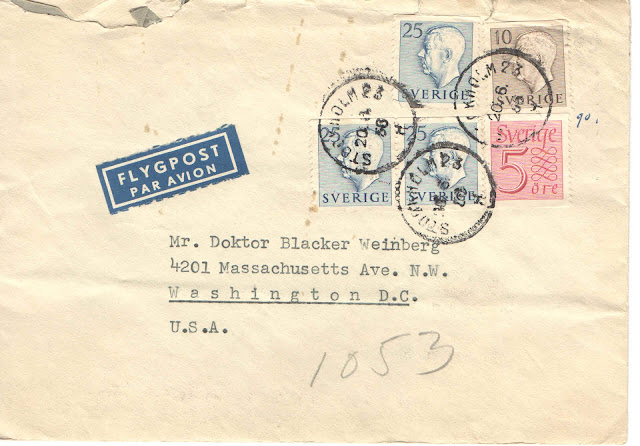

International letter  fee: 40 öre + airmail fee 5 - 10 g fee: 50 öre
1954, 4 February. 25 öre blue Gustaf VI Adolf type I. Qty: 456,000,000
1954, 12 April. 10 öre brown Gustaf VI Adolf type I. Qty: 320,000,000
1951, 29 November. 5 öre red-violet New Numeral Type, type I. Qty: 140,000,000


The 25 öre denomination of the Gustaf VI Adolf type I series came in four different issues. Some what of a record having in mind that the type I existed just between 1951 and 1956, a mere six years. The first 25 öre stamp from 1951 was grey. Its single use was domestic letter  - 20 g. A year later the 25 öre red showed up in July and the reason was that the rate for international postcards was raised from 20 öre to 25 öre. The rate for domestic letter  - 20 g was untouched. The stamps for international postcards have to be red since Sweden still complied to the UPU-colours of international mail which stated that the colour has to be red and no other denomination could be red. The effect of following these rules have been presented in this blog post. The red 25 öre was one of the last Swedish stamps to follow the UPU rules since Sweden abounded this practice in 1953. The next 25 öre stamp became blue and arrived in early 1954. There were no raises in the postal rates to trigger a change in colours. Instead the Swedish Post was a little bit unhappy with shades of the colours of the whole series. They thought that the previous colours often was to light and shallow. Finally in June 1957 a fourth 25 öre stamp was issued, this time in a brown colour. It was issued at the same time as the first stamps of the the new revised type II series. That is pretty strange - to issue both old and new stamps. What was the reason? You can find a part of the explanation in the next paragraph. The brown 25 öre was replaced with the 25 öre brown Gustaf VI Adolf type II in October 1957

However the blue 25 öre set a new standard for the colouring of the denomination for the domestic letter  - 20 g (the most common postal rate), not unlike the UPU-colouring practice that was just abounded. It became blue for the years to come resulting in 30 öre, 35 öre, 40 öre and 45 öre blue stamps, until March 1969, when the new stamp for domestic letter first weight class, the 55 öre Gustaf VI Adolf type III, became red. The postage rate for was raised from 25 öre to 30 öre in July 1957. The new 30 öre became blue to mark that this denomination was for domestic letter first weight class. The old 25 öre blue had then to be cancelled and was replaced by the 25 öre brown. Maybe the decision of keeping the blue colour for the most common rate was made pretty quickly and there was no possibility to engrave a new 25 öre in the type II version of the series? I think that is a likely explanation.

The 10 öre changed colours only once. The first 10 öre was green and had to be coloured that way because it single use was international printed matter, even if the rate was still 10 öre it got its new brown colour in April 1954.


The letter was sent on Wednesday 20 June 1956 and the stamps were cancelled at the Post Office Stockholm 23 at 16 Yngliga Saga Street (Ynglingagatan 16), the Ynglinga saga is an old Icelandic traditional folk saga. We have had a postal item sent from that Post Office before, look here.

The back of the cover tells us that the sender was Dr. Jakob Möllerström. He was quite famous and he is regarded to be the father of Swedish biochemistry, he did biochemical studies already in the 20s and was internationally recognized for his research. His son became quite successful also, but in another field, as a composer of music and later professor. His name was Bengt Hambreus.


23 August 2015

From the first one

Six stamps on a letter cover and the sum is 85 öre. This letter was bound for U.S. via airmail in December 1948. After some research I can not confirm any 85 öre postal rates for airmail to North America in 1948. The nearest I got is 80 öre for the weight class 5 - 10 g which was the rate effective from 1 January 1947 to 30 November 1949. My guess is that the sender did not have the right denominations at hand for exactly 80 öre and had to over frank the letter. The letter cover is not marked "5 g" which also indicates the higher weight class 5 - 10 g.


International letter fee 30 öre + airmail 5 - 10 g fee 30 öre,
over franked with 5 öre.
1948, 1 April. 10 öre green Gustaf V, right profile. Qty: 82,600,000, 3-sided perforation,
. . .  from the 84th booklet.
1945, 14 February. 15 öre brown Gustaf V, right profile, version I. Qty: 18,400,000 (pairs), 3-sided perforation,
. . . from the 71 th booklet.

According to the back side of the letter cover the sender was Professor Nanna Svartz, Stockholm. Mrs. Svartz was a pioneer in Swedish academics and she actually became the first female Professor in Sweden in 1938 at 48 years of age. She was a Professor in general medicine with a specialization in intestinal and rheumatic diseases.

To me it looks like it is a private letter to Dr. Amandus Johnson at Pennsylvania University. However that was apparently not the right address, some one has changed the address to 1300 Locus Street with a pencil. The Historical Society of Pennsylvania is residing at that address which indicates that Dr. Johnson is not a medical doctor. He was not, Dr Johnson was an American historian, author and the founder of the American Swedish Historical Museum. He came with is parents to Minnesota in 1880 when he was three years old. He became a quite famous Swedish-American, at least in Sweden.


8 August 2015

Holland Michigan

Ordinary Gustaf VI Adolf stamps


On Wednesday 1 April 1970 the incorporated company Proinvestements Scandinavia in Stockholm sent a letter to Surplus Service in the town of Holland in Michigan, US. Two 55 öre red Gustaf VI Adolf type II and one 10 öre blue/black Swedish ship in Öresund made 1.20 kr. The letter cover has no Air Mail label but the sum 1.20 kr was the rate for air mail letter to North America 5 - 10 g. The rate for sending the letter by surface would have cost 70 öre.  The 55 öre Gustaf VI Adolf single use was domestic letter  - 20 g since March 1969 until October 1971. Two 55 öre Gustaf VI Adolf would cover the fee for international letter 20 - 40 g. The 10 öre stamp was a complementary denomination and belonged to the quite revolutionary series called Definitive Stamps from 1967. Read more about the Definitive Stamps series - here.

Air mail to North America 5 - 10 g fee: 1.20 kr
1969, 28 February. 55 öre red Gustaf VI Adolf type III. Qty: 269,000,000
1967, 16 October, 10 öre blue/black Swedish ship in Öresund. Qty: 156,000,000

The letter was handled by the Post Office Nacka 1, but the address of the company Proinvestments Scandinavia was 33 King Street down town Stockholm, definitely a quite posh address, at least thirty years earlier. The closest Post Office would have been Stockholm 1. Nacka is a suburb south of Stockholm.


In 1970 the address of the sender was 33 King's Street in Stockholm. (Google). Just besides one of the two famous King's Towers, Stockholm's first skyscrapers,    . . . well, high raises) and the crossing bridge of  the Ridge Dividing Street (Malmskillnadsbron).
Read more about the King's Tower - here.

There are not much traces of Proinvestments Inc. The Surplus Service in Holland, Michigan, seems to have been in business at least during the sixties and seventies. The regularly advertised in magazines as the Popular Mechanics or the Field & Stream. They sold any kind of government surplus to the public. Just write for inquiries,  . . . so did indeed Proinvestment.


Add from Field & Stream July 1970.

4 August 2015

Bound for a box in Argentina

This letter cover has a some what puzzling address. I am not sure what Casilla means in Spanish, Casilla Correros seems to be mail boxes. Maybe it is a Post Office Box? That would mean mail box number 4327 in Buenos Aires. Must be a lot of Post Office boxes in that big city.

There are two 2 kr wine-red Three Crowns and a 20 öre green-black St Stephan, the Stable-Boy on the cover summing up to 4.20 kr. The letter was sent by air and it was also a registered letter. The postage rates for air mail have varied a lot over time and depending on which country. It is quite a research effort to sort that out, unlike surface mail that had a flat rate for every country since 1874.


Air mail to Argentina fee: 1.70 kr  + registered fee 2,50 kr
1971, 23 April. 20 öre green-black St Stephan, the Stable-Boy. Qty: 36,200,000
1969, January 20. 2 kr wine-red Three Crowns. Qty: 67,700,000

But there is one thing we know for sure - the fee for registered letter: 2.50 kr.  Then the air mail fee must have been 1,70 kr to Argentina in the fall of 1972. The registered fee was raised to 2.50 kr as of 1 October 1971.

The letter was dealt with at the Post Office Stockholm 1 the General Post Office at at Wasa Street on Thursday 30 November 1972. When Señor Juan Lukan received the letter is unknown.


19 June 2015

One went flying, the other went by ship

These two letters were sent the same day Thursday 3 August 1950 by the same sender. The peculiar thing is that one was sent as an air mail letter and the other one as an ordinary international letter to the same address. The airmail letter has three  20 öre red Gustaf V, right profile. They are all perforated on three sides, one pair and one single stamp and hence came from a booklet, actually from the 64th booklet by Swedish Post first issued in 1942. It contained 20 stamps and the cost was 4 kr. Three 20 öre stamps makes 60 öre and that was the fee for   - 5 g air mail to North America in 1950. The other letter, which is a  - 20 g international letter, has two 15 öre brown Gustaf V, right profile. They are also perforated on three sides and they are from the 71st booklet first issued in 1945. A closer look at the 15 öre stamps tells me that these are of version I. For example the band of medals on the king's chest are less detailed and light. (This post deals with the two versions.)


Top: airmail letter to North America fee: 60 öre
7 March, 1942, 20 öre red Gustaf V, right profile. Qty: 98,000,0000 (pairs), 3-sided perforation
Bottom:  - 20 g international letter fee: 30 öre
14 February, 1945, 15 öre brown Gustaf V, right profile, version I. Qty: 18,400,000 (pairs both versions), 3-sided perforation

The letters were taken care of the Post Office Stockholm 1, the Post Office was co-located with the head quarters of the Swedish Post at 28 - 34 Vasa Street (Vasagatan 28 - 34), where the Swedish Post filled up two blocks.

On the the other side of the letter covers the following is printed "Josef Kastengren, Buhlsjö, Österbymo". It turns out that Mr. Kastengren got the first formal driver license in Sweden in January 1907. Well, people were driving along without a license in those days, but this guy was the first one to get a permit the right way. He was a driving instructor and taught the Swedish royals to drive as well, actually he taught the king on the stamps, he was also a car salesman and a business man in the Swedish car industry. Quite a legend.


Eventually both letter reach their destination. 1100 E. Hector Street, Conshohocken, PA.
(Google street)

43 years after he got his license he still seemed to be in the business because the letters were sent to the well known Lee Tire and Rubber Company in maybe less known Conshohocken, Pennsylvania. Famous for its car tires.The factory was built in 1910 by John Ellwood Lee, in 1965 it was bought by Goodyear and it closed down in 1980. But it did not end there. The old factory ground was turned into offices and called Lee Park and lately it has undergone some major renovations. It got a new name too, Spring Mill Corporate Center. In 1984 it was added to the U.S. National Register of Historic Places.

The odd thing is that the letter that not was sent as an air mail letter has "5 gr" written by hand, indicating that some one bother to put in on a scale. It seems like it was supposed to be sent by air too, the way that the stamps are applied and that they are from booklets indicates to me that it was most likely not done by Swedish Post.
. . . ah well, the mystery will remain unsolved.

24 March 2015

Airmail letters to Hagerstown

Two letters - two orders - from two different decades

W. H. Reisner Manufacturing Company Inc. in Hagerstown, Maryland manufactured mechanical and optical instruments, stamped metal works, and did nickel plating, and in addition manufactured pipe organ hardware and accessories, the firm founded in 1902. They sold their products throughout the United States, and to many foreign countries, including England, France, Germany, Japan, Mexico, Cuba, Australia and even Sweden.

The letter cover at the top is from the firm Nygren's Fishing Equipment Shop at the Warehouse Street 12 (Magasinsgatan 12) in Göteborg (Gothenburg). Apparently they urgently needed new gear and sent an order by air mail to W.H. Reisner. I wonder what kind of products they ordered from far a away America? Nygren's was still in business in the seventies.

Top letter cover:
Air mail letter  - 10 g, letter fee: 30 öre + air mail fee: 20 öre
1921, September 6. 50 öre grey Gustaf V, left profile. Qty: 10,700,000 (white paper)

Bottom letter cover:
Air mail letter  - 10 g, letter fee 40 öre + air mail fee: 50 öre
1951, November 29.  5 öre red-violet New Numeral Type, type I. Qty: 140,000,000
1954, January 20. 40 öre olive-green Gustaf VI Adolf, type I. Qty: 24,300,000


Göteborg is the second largest city in Sweden and situated 397 km south west of Stockholm at the Atlantic coast of Sweden. The stamps were cancelled on Thursday 23 August 1945 at the Post Office Göteborg 2 at 3 Oak Groove St. (Ekelundsgatan 3) It is also stamped with the text "By air to the United Kingdom" which meant that the letter went by air to U.K, but by boat over the Atlantic.


The second letter cover is from 1954 and the sender is Hans Christian Schuster,  he was a pipe organ builder. Mr. Schuster was also a quite succesful long-distance runner. He won the Swedish championship 20,000 m in 1922 and participated in the marathon at the 1920 Summer Olympics, Antwerp, Belgium. The letter started its journey on Tuesday 6 April 1954 at the Post Office Stockholm 9 at 160 - 168 Horn's St. (Hornsgatan 160 - 168). This time the letter went by air all the way to North America.